
LINN — More than half a century after Linn R-2 began putting students into makeshift classrooms in the basement of the field house, the district celebrated a very different solution on Thursday.
Students, staff, school officials, and community members gathered on Thursday for a ribbon-cutting marking the completion of the district’s new addition and a series of campus improvements — projects Superintendent Bob James said represent years of planning, construction, and community investment.
James said the day’s significance stretched back much further than the most recent building campaign.
“I think we started thinking about this day sometime in 1973, when we put our first kids down in the basement of the middle school,” he said, adding the district did the best it could with existing property.
That attitude, he noted, has long characterized the district and community. “Like our community always says, we’re proud and grateful of what we have, and we make the best of it,” James said. “I hope that you guys are proud and grateful for what we’ve done here, and I can’t wait to make the best of it with you.”
James thanked residents for investing in the district’s students, staff, schools, and programs, emphasizing that the finished work was not the result of any one person.
“This is not me,” he said. “Everybody keeps thanking me. I did very little. I didn’t swing a hammer on anything. It was a team effort with a lot of different hands in the pie, and a lot of different bakers making it.”
Among those James recognized were members of the Board of Education, district employees, contractors, architects, vendors, volunteers, and project partners.
He offered particular praise for the district’s maintenance and custodial employees, whose workloads increased significantly during construction. “Their work has doubled, tripled, and quadrupled the last couple of years, and this summer has been incredibly rough,” James said. “They have done an awesome job.”
Students and their families also had to adapt as work continued around an active school campus.
“Traffic alone has been rough for a couple of years, just trying to figure it out, and you guys have given us a break the whole way, so I really appreciate that,” James said.
The district worked closely with Navigate Building Solutions and Bond Architects throughout the project. James said Tanner Smith of Bond Architects and district officials had worked “hand in hand for a couple of years.”
Those professional partnerships, however, were only one part of a much larger community effort.
James cited assistance from booster organizations, local businesses, the Osage County Road & Bridge Department, the Linn Lions Club, Linn Elementary PTO, and State Tech, among others.
He described the district’s relationship with State Tech as particularly valuable, recognizing R-2 board member Andy Warden and State Tech President Dr. Shawn Strong for repeatedly providing assistance when needed. “I don’t care what we need, whenever we need it — we need $5 million worth of bulldozers, they’re there,” James joked. “It’s absolutely an amazing thing.”
Although increased traffic generated by the neighboring college can sometimes be frustrating, James said the benefits of the relationship are considerable.
“Man, oh man, the benefits of our partnership are outstanding,” he said.
James also recognized State Tech groundskeeper Joe Malaro for his work on Linn’s practice fields and athletic facilities, saying Malaro takes “special pride” in projects undertaken for the district.
Linn Elementary PTO members, including Matt McCoy, Mitch Branson, Terry Shepherd, and other volunteers, contributed significant work. “They have dedicated countless hours to our elementary playground,” James said. “It’s absolutely amazing what they’ve done.”
James also recognized committee members who helped the district determine how the project could best serve students, staff, and the community, along with the Wildcat Football Boosters and Mitch Swann and his sons.
Their assistance, James stressed, has extended far beyond athletics. “Nearly every project we have — and it’s not just sports — if I asked them to help me write this speech, they would have brought it to me spit-polished,” James said. “They will help with anything.”
Beyond the new construction itself, James said careful financial management allowed the district to stretch the bond proceeds considerably further than initially anticipated.
The district had approximately $12.5 million in bond funding available for the work, he said. A conservative investment strategy generated nearly another $1 million while the money awaited use.
Savings through bidding, project management and what James described as careful stewardship created roughly another $1 million in available capacity.
As a result, he said taxpayers will receive substantially more in completed projects than the original bond amount alone might suggest. “For the bond that we had, $12.5 million, we’ll get about $14 million to $15 million worth of projects out of this,” James said.
That additional capacity allowed the district to address needs that were not originally included in the plan.
Among them is the replacement of the entire heating, ventilation, and air conditioning system at the roughly 25-year-old high school.
James said taking care of that work now will prevent the aging system from becoming a major expense later.
“We’ll replace the entire HVAC in our 25-year-old high school so that’s not a burden on future Wildcats and future budgets,” he said.
Board President Mark Baker said the finished work is part of something larger happening throughout the Linn school community. “I’ve had others from outside of our community ask what’s going on here in Linn, and it’s something good,” Baker said.
He pointed to increasing volunteerism and what he described as “a slow, deliberate cultivation of our environment of encouraging learning and collaboration.”
“We’ve got something special here, and it’s been really neat to see,” Baker said.
He also thanked students, teachers, administrators, current and former board members, parents, and community members who helped carry the multi-year effort to completion.
“This has been a multi-year project with several terms of board members to get this across the finish line,” Baker said.
Families, meanwhile, dealt with construction disruptions throughout the process. “There’s been lots of disruptions, and I think everybody’s handled it well,” Baker said. “I think the end result is well worth it.”
Ultimately, Baker said, the work would not have happened without voters supporting the bond issue. “Without passing the bond issue a few years ago, this wouldn’t have happened,” he said. “We were able to do a lot of things that needed to be done, and the result is pretty amazing.”
Baker described the projects as more than investments in buildings.
“This is an investment in our community,” he said. “This is an investment in our children and our future, and I think it’s something to be proud of.”
The ceremony also reflected another change James hopes to see continue throughout the district — students taking greater responsibility for the culture and direction of their school.
Before introducing Student Council President Nicole Grellner, James said the district is working to reframe the role students play on campus. “It’s not a bad thing, if it’s done well, to have students run your school,” James said. “It can be a wonderful thing if they do a great job of that and they hold themselves to high standards.”
That means students leading and supporting one another while working with adults and developing into future leaders. “Our student council has taken that on,” James said. “This is one of the first efforts that you’re going to see, along with some other future projects, where our students begin to lead our schools.”
He said that leadership should extend across the district — academically, through school programs and on athletic fields.
Grellner, speaking on behalf of the student body, thanked the school board, administrators, staff, and community members who made the improvements possible. “Living in a small town, the community is the backbone of support for our students,” she said.
That support, Grellner added, ranges from attending school activities to providing opportunities that can shape students’ futures. “This community is one that every student should be proud to be a part of,” she noted.
Grellner said students recognize that the new facilities represent an investment made on their behalf. “Just know that it is truly appreciated by all the students that everyone has invested in our future by giving countless new opportunities, including this new building,” she said.
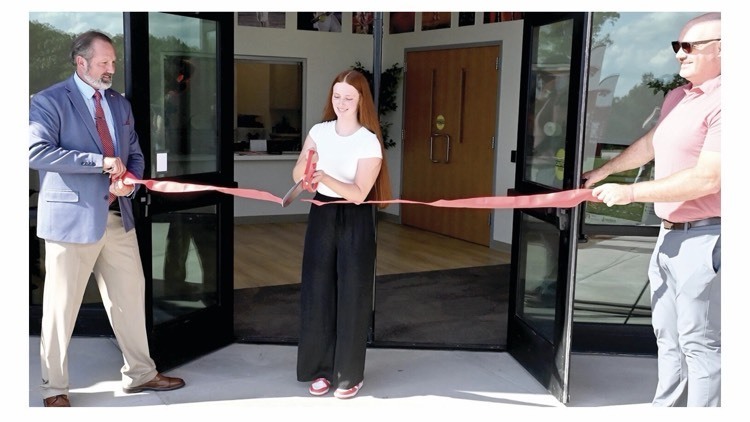
With the speeches complete, Grellner was given the honor of cutting the ribbon.
James then invited the crowd inside rather than keeping anyone standing in the heat any longer.
After years of planning, disruption and construction — and, by James’ reckoning, a need that could be traced to those basement classrooms of 1973 — the doors were finally open